Driven by Passion: Inside Formula Student Thailand 2025 with 5 University Teams
This January 2025, Thailand’s brightest engineering students came together at Formula Student Thailand, where innovation, teamwork, and speed take center stage. Among many universities competing in the event, we had the privilege of speaking with five teams from Chulalongkorn University, Prince of Songkla University, King Mongkut’s University of Technology Thonburi, Khon Kaen University, and King Mongkut’s University of Technology North Bangkok.
Formula Student is more than just a race—it’s a showcase of engineering ingenuity, resilience, and collaboration. These students aren’t just building cars; they’re crafting dreams, overcoming real-world challenges like limited budgets and high-pressure deadlines, and turning their ideas into vehicles that perform on the track. In this interview series, we take a closer look at how these five university teams approached the competition, their innovations, and what fuels their drive to excel in Formula Student Thailand. Let’s explore the stories behind the students, the universities, and their incredible racing machines.
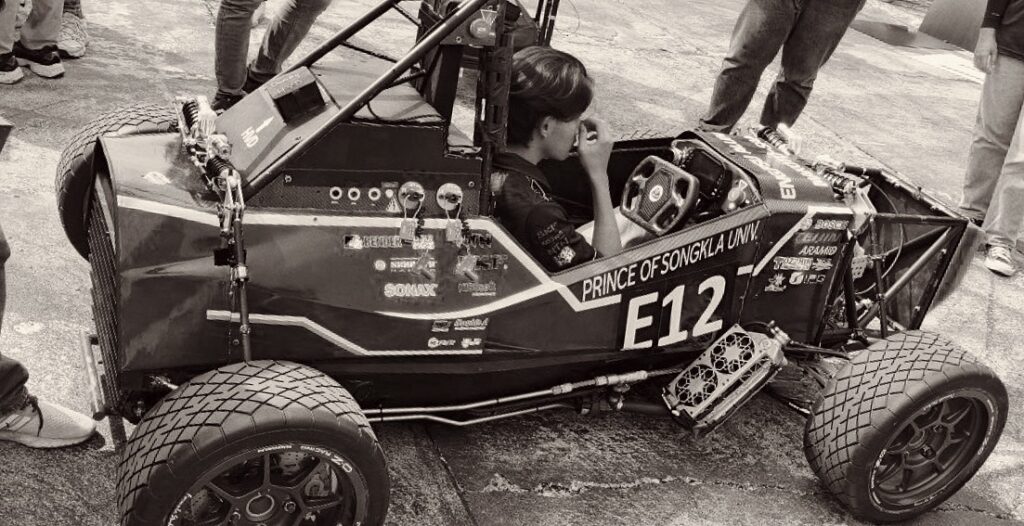
Prince of Songkla University(Lookprabida)
Q: Hello, which team are you from?
A: We’re from Prince of Songkla University.
Q: Does your team have a name?
A: Yes, our team is called “Lookprabida”
Q: When you start designing, what’s the first step?
A: We start by setting a target. For example, if we aim to be number one, we figure out how much time we need to achieve in each event. Then we move on to the design phase.
Q: What are the steps in your design process?
A: There are three main steps. First, we set the target. Then we decide on the method—how we’ll design and which approach to use. Finally, we move on to verification, where we test and measure the actual results and compare them to our simulations or calculations.
Q: Which step do you find the most difficult?
A: I’d say the verification step. It requires highly accurate tools, and we have to use specialized equipment to measure everything precisely.
Q: Do you handle everything yourselves?
A: Yes, we do everything on our own.
Q: What kind of brakes do you use?
A: We use ISR brakes. It’s a Swedish brand.
Q: How much is your yearly budget?
A: In the past, when we were using fuel-powered cars, it was around 1 million baht per year. Including all the competitions in Thailand and Japan, it totaled about 3 million baht. But now that we’ve switched to electric, it’s around 4 million baht.
Q: That’s a lot!
A: Yeah, this is actually the first year we’ve gone electric, so we had to buy a lot of new parts. We couldn’t reuse much from last year’s car.
Q: Do you have any details about the suspension system?
A: For the shocks, we use Ohlins. They make custom ones specifically for Formula Student competitions.
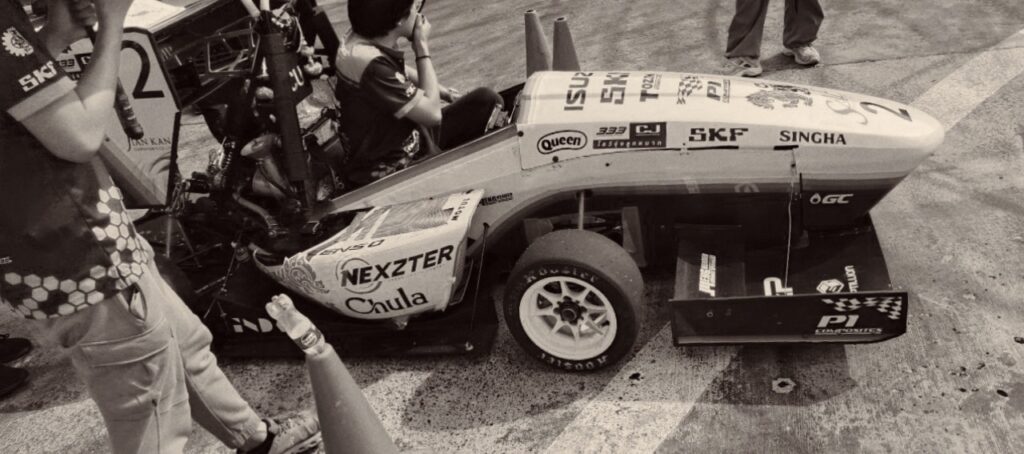
Chulalongkorn University (RapidAmente)
Q: Hello, which team are you from?
A: We’re from Chulalongkorn University.
Q: When you start designing, what’s the first step?
A: We start by designing the frame, then the outer structure of the car, followed by the suspension. After that, we work on the Geo—deciding how the suspension will be positioned within the frame. Then we move on to the powertrain and electrical systems.
Q: What’s Geo?
A: It’s the layout of the car’s suspension—basically, how and where the suspension is positioned.
Q: What materials do you use for the exterior?
A: We use a variety of materials, like steel, stainless steel, carbon fiber composites, and fiberglass.
Q: What kind of brakes do you use?
A: We use Nexzter brake pads, but for the actual brake system, we order Wilwood parts from overseas.
Q: What about the suspension and shocks?
A: We use Ohlins.
Q: Oh, and how much is your yearly budget?
A: It depends on the team. The budget usually starts at around 400,000–500,000 baht but can go up to 1 million baht.
Q: Is there anything interesting about the design process?
A: It really depends on the team and their goals. Everyone has different ideas about how to make the car perform its best. It’s about balancing speed, reliability, and stability—and it also depends a lot on the driver.
Q: So how do you begin the design? Do you sketch it first?
A: We usually start with CAD. Once the design is done in CAD, we move on to making the actual car. It depends on the part—there are different methods for different parts. For example, if it’s something we can’t produce ourselves, like a knuckle that needs CNC machining, we’ll send it to a factory or get help from sponsors.
Q: Are there any parts you can make yourselves?
A: Yes, we can make some of the simpler parts ourselves, like milling, welding, cutting, and assembling the frame.
King Mongkut’s Institute of Technology North Bangkok, Rayong Campus. (Pho-tech team)
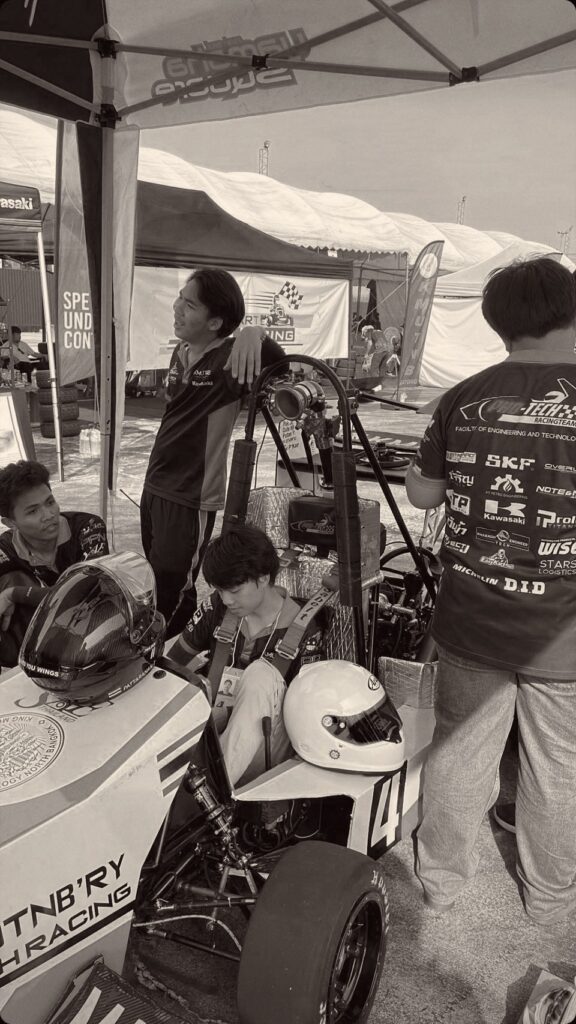
Q: Hello, which team are you from?
A: Hello, I’m from the Pho-tech team at King Mongkut’s Institute of Technology North Bangkok, Rayong Campus.
Q: I’d like to ask, when designing, where do you usually start?
A: Designing our car is like promoting it—showing how good and functional it is and highlighting its interesting features. For instance, our car has adjustable wings and a rear brake that folds up to increase air resistance, which improves braking efficiency. We also focus on the car’s alignment and suspension, ensuring that the suspension grips the road well during cornering.
Q: What kind of brakes do you use?
A: We currently use Wilwood brakes, including the brake pedal and slipper. These brakes come with built-in balance, so they perform exceptionally well. That’s why we decided to switch to this system.
Q: What about the suspension?
A: We create the alignment and build the suspension system ourselves. Since our car has a low center of gravity, we need a suspension that is firm and grips the road effectively. We don’t need to install a stabilizer bar to reduce body roll.
Q: How important is lightness?
A: Lightness is extremely important. Our car’s engine produces around 650cc or 80–90 horsepower. If the car is too heavy, it will run slower.
Q: What are the standout features of your suspension system?
A: One key aspect is that we aim to build as much of the car as we can ourselves. Our university’s budget is quite limited compared to other universities that receive around 200,000–300,000 baht. So, we make the most out of the budget by relying on the skills of all our team members to maximize efficiency and results.
Q: What materials do you use for the exterior?
A: We mainly use steel and aluminum.
Q: There’s no carbon fiber due to budget constraints, correct?
A: That’s correct.
Q: Is there anything you do to compensate for the weight since the materials are heavier?
A: We use aluminum sheets to help reduce weight further. However, the process of folding and welding aluminum requires a significant amount of skill.
Q: Oh, it sounds like you’re still on par with other teams!
A: Haha, we’re doing our best.
Q: Thank you very much.
A: You’re welcome!
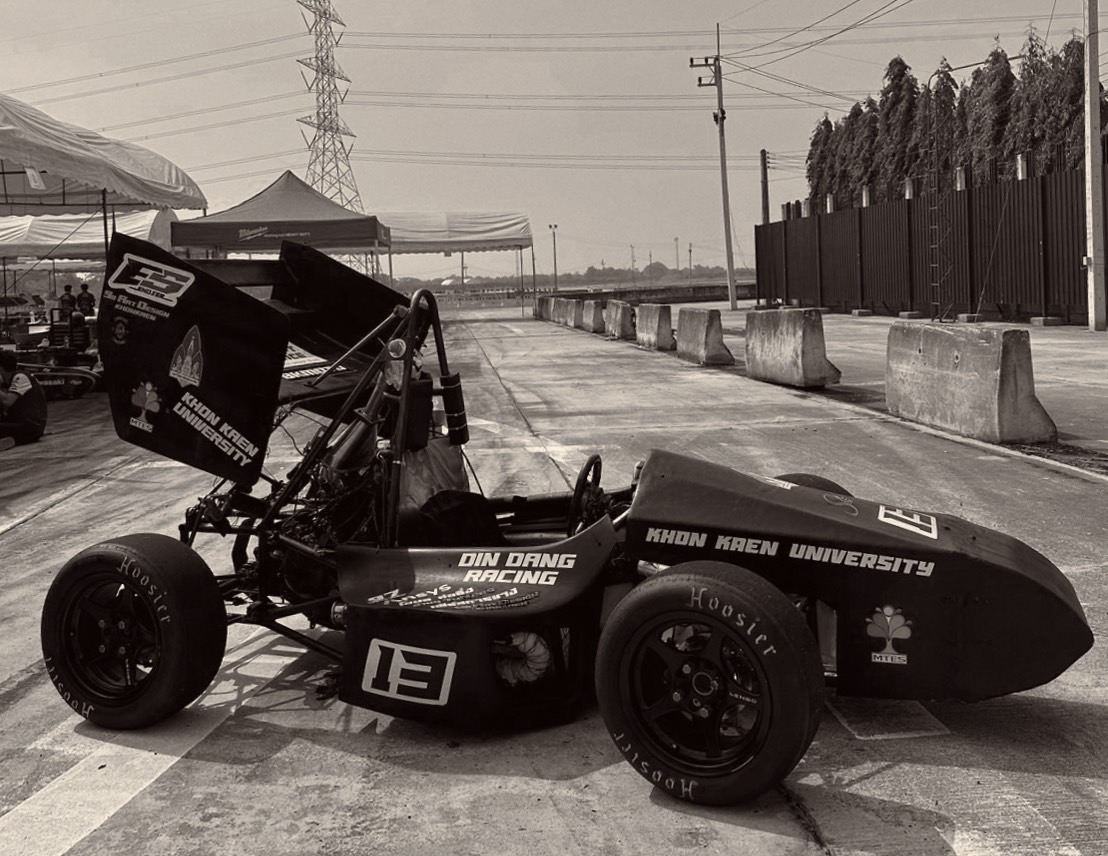
Khon Kaen University (Din-Daeng Racing)

Q: Hello, which team are you from?
A: Hello, I’m from the Din-Daeng Racing team at Khon Kaen University.
Q: I’d like to ask, what are the steps in your design process?
A: The first step is to consider the budget because ours is quite limited. Most of the equipment we use is from older cars. Once we reuse these parts, we redesign and optimize them to achieve the best performance. For example, in the suspension system, we apply our knowledge of sensors to optimize the car’s body roll. Another key aspect is the use of technology, like automatic adjustments for steering based on the calculated steering angle. This helps improve handling and cornering.
Q: What materials do you use for the exterior?
A: As I mentioned, we are constrained by the budget. For the wings, we use a mix of carbon fiber and fiberglass. For the chassis, we use standard steel. However, one feature we’re proud of is our electric gear shifting system, known as paddle shift.
Q: What kind of brakes do you use?
A: We use Brembo brakes.
Q: And what about the suspension and shock absorbers?
A: We use YSS shock absorbers.
Q: What about the wishbone?
A: Are you referring to the wishbone? For us, it’s part of the A-arm design. We design the suspension system to work with the roll center, determining the intersection point of the A-arms. This allows us to calculate the most suitable intersection distance for optimal performance.
Q: What are the key strengths of your car that you believe make it competitive with other teams?
A: For our team, I think our main competitive edge lies in the technology we’ve developed to optimize cornering performance. In a track like this, with short, sharp corners, you can’t rely on high speeds. Instead, the key is to maintain speed while ensuring the wheels stay firmly on the road. To achieve this, we’ve implemented adjustable wing technology.
Q: Is it controlled by automatic sensors?
A: Yes, it’s controlled by a sensor in the steering wheel that measures the turning angle. Based on this, the wing adjusts accordingly. For example, when turning right, the left wheel may lift slightly, it doesn’t grip the road, so we have to find additional downforce to ensure the wheels stay firmly planted, allowing us to take the turn at a higher speed compared to other teams. This is one of our strengths.
King Mongkut’s University of Technology Thonburi. (Black Pearl)

Q: Hello, which team are you from?
A: Hello, I’m from Black Pearl Racing, a team from King Mongkut’s University of Technology Thonburi.
Q: I’d like to ask, what are the steps in your design process?
A: We start by defining the concept of the car—deciding what character it should have and what we want to achieve with it. It’s like setting a goal: we identify the kind of success we want, which then determines the direction we take to make it happen.
Q: What do you think is the most challenging part of the design process?
A: For EV cars, I’d say the electrical system. The mechanical system is something we’ve already studied in mechanical engineering, so it’s quite basic and something we’re familiar with. But the electrical system is new, quite complex, and very challenging to design.
Q: What do you use for brakes and suspension?
A: For smaller components, we might use OEM parts, which are generally used in racing cars. However, for parts like brake pedals or accelerators, we design and fabricate them ourselves to ensure they fit the size and specifications of our car.
Q: What are the standout features of your car?
A: This year, we’re working under the concept of ‘Laconic,’ which means ‘less talk, more action.’ If you look closely, you’ll notice that our car has relatively few components. However, that simplicity conceals a great deal of complexity.
Q: Is there anything important about building a racing car that stands out to you?
A: Aside from the technical aspects, building a car like this requires a lot of mental discipline. It’s not easy to produce just one car—it takes a significant amount of time and passion.
Q: How long does it usually take to build one car?
A: It typically takes about a year to complete one car.
Q: So, if you compete every year, does that mean you’re constantly building?
A: Yes, exactly. And it depends on the goals for the following years. Sometimes we take an existing car and further develop it, while other times we design an entirely new one.
Q: May I ask what the annual budget is for your team?
A: The budget is roughly around 1 million baht per car.
Q: What materials do you use for the exterior?
A: For the exterior, we use materials like carbon fiber, aluminum, and similar lightweight options.